
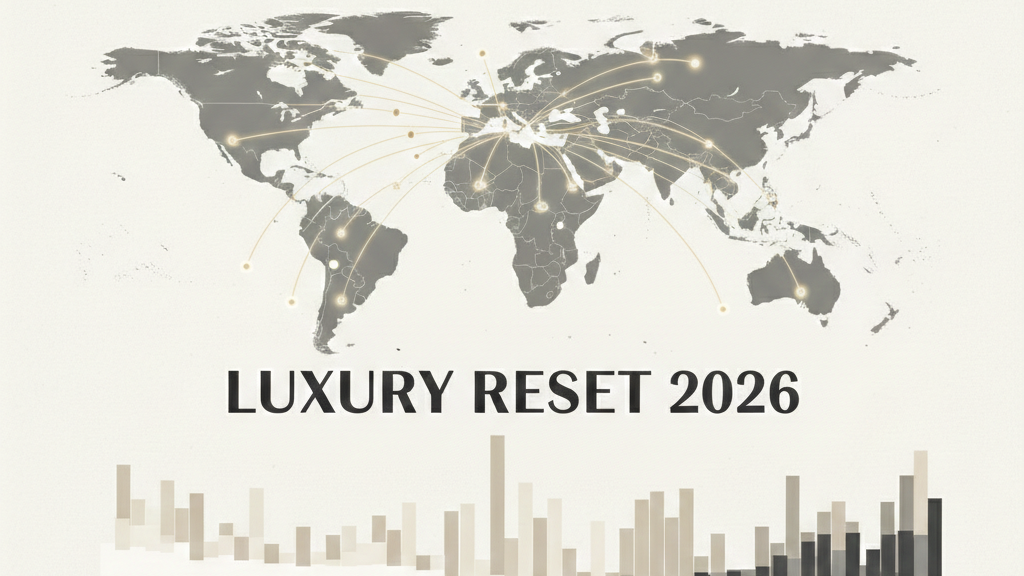
As we draw nearer to 2026, here are some quick market insights that luxury brands should take note of for a brighter future in the coming years.
Luxury’s New Economic Geography
The global luxury sector enters 2026 at a decisive turning point. Two of the industry’s most respected intelligence sources — Bain & Company with Altagamma, and The Business of Fashion with McKinsey — independently paint a picture of an industry under pressure yet on the brink of a major geographic realignment.
While global luxury spending stands at €1.44 trillion, essentially flat, and personal luxury goods stabilise around €358 billion, the headline numbers conceal a deeper shift: luxury’s next wave of growth will no longer be anchored in a single geography.
For the first time in modern luxury history, five emerging regions — India, the Middle East, Southeast Asia, Africa and Latin America — collectively equal Mainland China’s luxury market.
As Bain notes: “Middle East, Latin America, Southeast Asia, India, and Africa combined represent a market value of around €45 billion in 2025 — matching Mainland China in scale.”
This is far more than a statistical milestone. This is the beginning of luxury’s new multi-polar growth era.
A New Power Bloc Emerges
China’s two-decade dominance as global luxury’s growth engine is now balanced by a rising coalition of fast-modernising, upwardly mobile markets.
Together, these five regions form luxury’s next super-region, powered by:
- India’s booming affluent and UHNW population
- The Middle East’s sovereign-backed tourism and retail ecosystems
- Southeast Asia’s Gen-Z-led premiumisation
- Africa’s creative luxury renaissance and rising urban elites
- Latin America’s concentrated metropolitan wealth
The message to global luxury leaders is clear: This is no longer a China-plus-one world. It is a China-plus-new-frontier-bloc world.
Brands that pivot early will capture disproportionate value.
Creativity and Craftsmanship Return to Centre Stage
Both Bain and BoF–McKinsey confirm that luxury’s “price-led decade” has ended. Aspirational buyers have reached their tolerance limits, and the global customer base has contracted from nearly 400 million to around 340 million.
In 2026, desirability must be re-earned, not priced in.
Luxury’s core value drivers are reasserting themselves:
- Craftsmanship
- Material excellence
- Creative originality
- Narrative depth
- Emotional resonance
- Distinctive client experience
The wave of new creative directors across global maisons underscores this shift. The next icons of luxury will emerge from brands that return to the artistry that originally defined the sector.
Experience, Wellbeing and Jewellery Take the Lead
The most profound consumer shift is psychological: customers want emotional value, not display value.
According to Bain, the fastest-growing categories include:
- Experiential luxury — hospitality, cruises, fine dining
- Jewellery, expanding at 4–6% annually
- Accessories, resilient and stable
- Premium beauty and skincare
- Smart eyewear, expected to exceed $30 billion by 2030
Consumers across geographies — especially Gen Z and millennials — are shifting from accumulation to self-expression, wellbeing, and meaningful experience.
Luxury brands that build ecosystems rather than product lines will emerge stronger.
AI Becomes Luxury’s Operating System
The BoF–McKinsey study positions AI as the single greatest opportunity for the industry.
In 2026, AI will accelerate:
- AI-led product discovery
- Hyper-personalised clienteling
- Predictive retail and merchandising
- Creative augmentation in design
- Digital twins and supply-chain visibility
- Enhanced omnichannel service
- Performance within AI-driven shopping agents (the new SEO)
Brands that embed AI into their organisational DNA will gain cost efficiency, creative acceleration and competitive visibility.
Tariffs and Sourcing Complexity Make Agility a Strategic Imperative
US tariffs peaking at 54% in 2025 created seismic disruptions. Fashion and luxury sourcing is shifting from traditional hubs toward more diversified and resilient ecosystems across Cambodia, Mexico, India and Africa.
Both reports converge on a single truth: Agility is now the most important competitive advantage.
Luxury supply chains, long optimised for precision and craftsmanship, must now be redesigned for resilience, redundancy and regional flexibility.
The New Mandate for Luxury Leaders
The merged intelligence from Bain and BoF–McKinsey points toward a dual transformation shaping luxury’s next decade:
1. Reignite Desirability
- Creativity, craftsmanship and cultural relevance
- Jewellery and accessories leadership
- Experience-led ecosystems
- Emotional storytelling
- Authentic brand purpose
2. Engineer Structural Resilience
- Embed AI into creative, commercial and operational processes
- Build multi-market sourcing models
- Strengthen organisational agility
- Prioritise the new €45B frontier super-region (India + ME + SEA + Africa + LatAm)
- Shift from reach to precision — defined client segmentation, not mass appeal
Luxury’s next great chapter will belong to the maisons that embrace this reset with clarity and conviction.
Conclusion
As luxury enters this new era of multi-polar growth, the brands that will define the decade are those that recognise the magnitude of the geographic realignment already underway. The emergence of India, the Middle East, Southeast Asia, Africa and Latin America as a combined China-sized luxury force marks a structural pivot that will reshape investment priorities, creative direction, and leadership agendas across the industry. In a world where desirability must be rebuilt and resilience must be engineered, success will belong to the maisons that read these signals early, reframe their strategies boldly and respond with the agility that today’s reality demands.
The next chapter of global luxury will not be written in one capital — but across a constellation of dynamic markets whose collective influence is now too powerful to ignore.
This article was first posted on Dec 10, 2025 by LuxuryFacts editor Soumya Jain Agarwal | The Luxe Reset 2026: The Rise of the Next China-Sized Luxury Power Bloc