
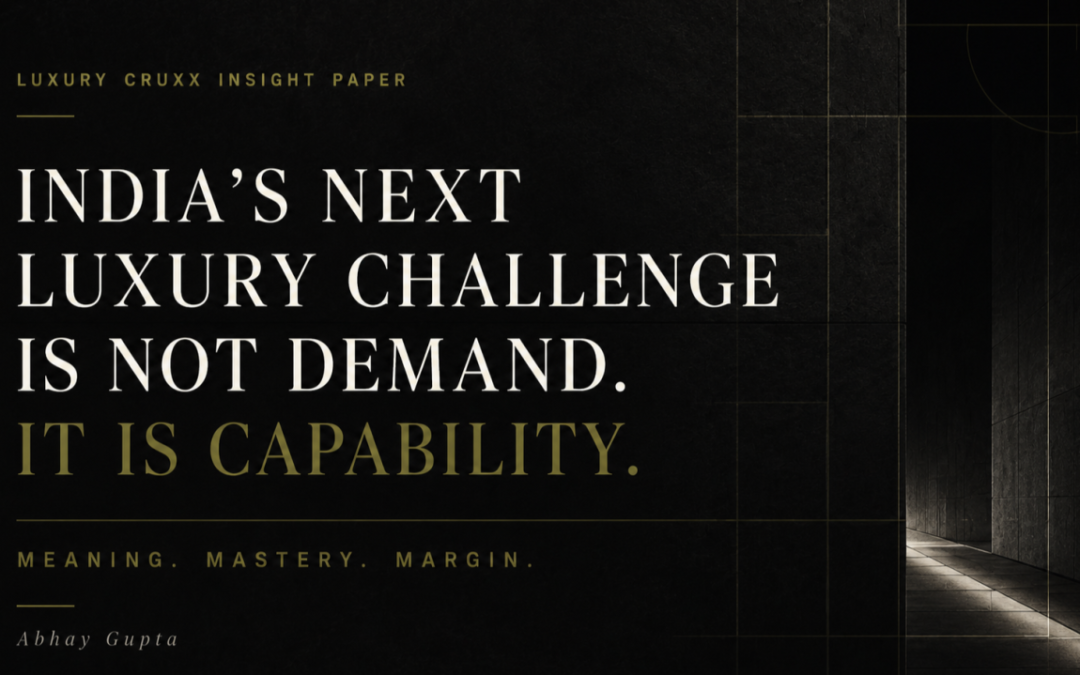
India no longer has a luxury demand problem. The consumer is already here.
The aspiration is visible. The wealth is expanding. The exposure is global. And the appetite for premium experiences continues to deepen across sectors.
From hospitality and fashion to beauty, automobiles, fine jewellery, watches, and lifestyle services — India’s luxury economy is undeniably growing.
And yet, a more uncomfortable question remains largely unanswered.
Why does a country with such extraordinary cultural depth, craftsmanship, and consumption still struggle to consistently produce enduring global luxury houses?
Not products. Not moments. Not seasonal hype.
But institutions of luxury.
The answer, increasingly, may lie in a missing layer that sits between creativity and continuity:
capability architecture.
Luxury is often misunderstood in India as a product category.
In reality, it is a systems discipline.
The strongest luxury brands in the world are not built merely through aesthetics, craftsmanship, or visibility. Those may create attraction.
What sustains luxury over decades is something far more demanding:
the ability to institutionalise excellence consistently across every layer of the experience.
That includes:
- Retail behaviour
- Clienteling
- Narrative discipline
- Service standards
- Product consistency
- Training systems
- Leadership patience
- Operational precision
- Cultural coherence
- And long-term positioning clarity
Luxury compounds through consistency.
And consistency is ultimately a capability problem.
India already possesses many of the raw ingredients required for luxury leadership.
We have:
- Extraordinary artisanship
- Cultural richness
- Emotional storytelling potential
- Rising global confidence
- And, one of the world’s most rapidly expanding premium consumer bases
But somewhere between craft and enduring brand-building, fragmentation often begins to appear.
Execution becomes inconsistent. Narratives become diluted. Retail loses coherence. Service standards fluctuate. Growth outpaces systems.
In many cases, brands attempt to scale before they have institutionalised discipline.
And luxury is rarely forgiving of inconsistency.
This becomes even more visible in the age of rapid premiumisation.
India’s startup ecosystem has become exceptionally strong at:
- Building products
- Scaling distribution
- Driving visibility
- And creating valuation momentum
But premiumisation requires a very different operating philosophy. Because luxury is not merely about selling more. It is about constructing cultural capital.
That demands:
- Restraint
- Patience
- Orchestration
- Symbolic depth
- And, long-term trust accumulation
The challenge is no longer whether India can create brands. The challenge is whether India can consistently build brands that endure across generations without diluting meaning in pursuit of speed.
Over time, I believe a new category of leaders will become increasingly important within Indian luxury:
‘ORCHESTRATORS’
Not merely creators. Not merely marketers. Not merely operators. But individuals capable of aligning:
- Craft
- Systems
- Storytelling
- Talent
- Experience
- Culture
- And, discipline
into one coherent luxury ecosystem. Because luxury today is no longer built through product alone. It is orchestrated through consistency.
This conversation is no longer limited to luxury alone.
It increasingly affects:
- Hospitality
- Fashion
- Beauty
- Premium retail
- Mobility
- Wellness
- Education
- And experience-led businesses across India
The next decade may not simply reward the loudest brands. It may reward the most institutionally disciplined ones.
Over the past several months, I’ve been studying these patterns more closely through conversations across founders, operators, luxury professionals, educators, and emerging premium businesses.
This led me to develop a deeper strategic framework around what I believe is India’s evolving luxury capability gap. I’ve compiled those observations into a new white paper:
INDIA’S LUXURY CAPABILITY GAP
The Missing Layer Between Craft, Consumption, and Global Brands
The paper explores:
- Capability architecture
- Luxury systems
- Institutional discipline
- The rise of orchestrators
- And why the frame work of ‘Meaning. Mastery. Margin’. may become increasingly important to the future of Indian luxury.

WHITE PAPER ACCESS
The full white paper is available on request via link below : https://forms.gle/d4J3ZCUDGFzvrLyz8
I’ll also be sharing future research notes, strategic insight papers, and luxury frameworks with subscribers through Luxury Cruxx over the coming months.